On cash alone, bivouacking is cheaper: six nights of beds and meals come to 378.35 EUR at the huts against 89.45 EUR bivouacking and cooking for yourself, using the prices each hut published as of 27 August 2026. Once you add getting there, parking, the food you carry and the tent you have to buy, the whole trip costs 751.33 EUR in a dorm on half board against 636.68 EUR bivouacking and self catering: the comfort premium is 114.65 EUR, or 15.3 per cent of the trip, driving from the UK. And the middle position does not exist any more on this circuit, because two of the six huts no longer allow bivouac at all, so a bivouac walker pays for two hut nights whatever they do.
Last checked: 27 August 2026. Hut tariffs are set season by season and the retrieval date is part of every figure below.
The circuit costed here
The Parc national de la Vanoise publishes the Tour des Glaciers de la Vanoise on its own Explore la Vanoise platform as a loop of 4 to 7 days from Les Fontanettes at Pralognan-la-Vanoise: 82.2 km and 5,201 m of ascent. This page costs the full version, seven days and six nights, which is the one the park lays out stage by stage.
- Night 1, Refuge du Col de la Vanoise, 2,517 m
- Night 2, Refuge de l'Arpont, 2,309 m
- Night 3, the Aussois and Plan d'Amont sector, priced here at Refuge de Plan Sec, 2,320 m
- Night 4, Refuge de l'Orgère, 1,935 m
- Night 5, Refuge de Péclet-Polset, 2,474 m
- Night 6, Refuge de la Valette, 2,590 m
Stage 3 ends where four huts sit within twenty minutes of each other, so Plan Sec stands in for the sector and Fond d'Aussois, Dent Parrachée and La Fournache are the alternatives. Walkers who extend the loop north and east onto the GR55 pick up Refuge des Barmettes, Refuge d'Entre Deux Eaux, Refuge du Plan du Lac, Refuge de la Femma and Refuge de la Leisse instead. Those are not stages of the tour as the park publishes it, so they are not in the totals.
The method here is a 2024 spreadsheet from a real trip on the same loop, entered from Maurienne rather than Tarentaise. Five of its six hut nights are stages of the standard circuit. The prices have been replaced with the current season's; the structure of the comparison has not.
What each stop charges now
Per person, in euro, as published on the retrieval date. Where a hut does not publish a line item, it says so rather than carrying a guess.
- Refuge du Col de la Vanoise, FFCAM. Bivouac: not permitted in 2026. Dormitory night 27.50, dinner 28.00, breakfast 12.00, picnic 12.50, tourist tax 0.80, self-catering supplement 3.00. Half board is published at 68.30, which is the night plus dinner plus breakfast plus the tax, so the tax is already inside the package rate. Book at refuges-vanoise.com in the guarded season, 3 June to 19 September 2026, or at refugecoldelavanoise.ffcam.fr outside it. Retrieved 27 August 2026.
- Refuge de l'Arpont, Parc national de la Vanoise. Bivouac 6.00, dormitory night 23.00, dinner 25.00, breakfast 12.00, picnic 12.00, tourist tax 0.85. Book at refuge-arpont.vanoise.com. Retrieved 27 August 2026. The hut's page on the shared refuges-vanoise.com site still showed 2023 rates that day; the hut's own site carries the current table, and that is what is used here.
- Refuge de Plan Sec, private. Bivouac 6.00, dormitory night 26.00, dinner 26.00, breakfast 11.00, picnic 12.00, tourist tax 0.85. Cash or cheque only. Book at refuges-vanoise.com. Retrieved 27 August 2026.
- Refuge de l'Orgère, Parc national de la Vanoise. Bivouac 6.00, dormitory night 24.00, dinner not published, breakfast not published, picnic 11.00, tourist tax 0.85. The tariff table has three columns only: night, half board at 59.00, full board at 70.00. The picnic figure is the difference between the two, not an estimate. Book at refuges-vanoise.com. Retrieved 27 August 2026. This hut is not in our own hut index, so there is no HutScanner page to link to.
- Refuge de Péclet-Polset, FFCAM. Bivouac: not permitted at the refuge. Dormitory night 30.80, which includes the self-catering room and crockery, dinner not published, breakfast not published, picnic 12.60, tourist tax included in the published rates. Half board 68.70. Book at refuges-vanoise.com. Retrieved 27 August 2026.
- Refuge de la Valette, Parc national de la Vanoise. Bivouac 6.00, dormitory night 22.00, dinner 24.00, breakfast 12.00, picnic 13.00, tourist tax 0.80. These are the 2025 rates: 2026 prices are not published for this hut, and the page still carried last season's table on the retrieval date. Cash or cheque only. Book at refuges-vanoise.com. Retrieved 27 August 2026.
Two figures move the whole comparison. The bivouac fee is 6.00 at every hut that still takes bivouackers, and it has not moved in two seasons. The dormitory night ranges from 22.00 to 30.80.
The two huts that changed the answer
Refuge du Col de la Vanoise states plainly that bivouac has been withdrawn: given the volume of visitors and what that does to the hut's waste-water system, it is no longer allowed there. Refuge de Péclet-Polset says bivouac is not possible near the hut and points walkers to the alpage de Ritord, an hour away toward Pralognan.
Those are nights 1 and 5 of a six-night loop. A walker carrying a tent still buys a bed on both, and still buys it at the full published rate, because neither hut sells a bivouac option any more. That is the single largest reason the cash gap has narrowed since 2024: two of the six bivouac fees have become two of the most expensive dormitory nights on the circuit.
The park's own rule is the other half of it. In the core of the Vanoise, bivouac is allowed in summer only in the immediate vicinity of certain huts, on that hut's designated area, between 19h and 8h, with a reservation made with the guardian, and places per hut are capped. Pitching anywhere else, with or without a tent, is prohibited and carries a fine. Bivouac in the Vanoise is a hut service, not an alternative to huts.
Six nights, beds and meals only
Totals per person for the six nights, in euro, using the prices above. The bivouac rows already include the two forced hut nights.
- Bivouac, self catered: 89.45
- Bivouac, dinner at the hut: 262.35
- Bivouac, half board: 309.35
- Bivouac, all meals: 382.45
- Dormitory, dinner at the hut: 333.35
- Dormitory, half board: 378.35
- Dormitory, all meals: 451.45
Two of those rows need a note. At Refuge de l'Orgère and Refuge de Péclet-Polset dinner is not sold as a separate line, so the "dinner at the hut" rows buy half board at those two stops and get a breakfast they did not ask for. That is what the published tariffs allow you to buy, so that is what is costed.
Fixed costs, and the point of the exercise
Beds and dinners are the part of a trip that people compare, because they are the part with a price list. They are not the part that decides what the trip costs. Below is the rest of it, per person, with two people sharing a car.
Worked example A, fly and hire a car. Return flight from London to Geneva booked well ahead, 140.00. Small hire car for eight days, 320.00 shared two ways, 160.00. Fuel Geneva to Pralognan and back, 400 km at 7 l/100 km at 1.85 per litre, 51.80 shared, 25.90. Motorway tolls 30.00 shared, 15.00. Parking at Les Fontanettes, 44.00 for six consecutive days plus 10.00 for the seventh, 54.00 shared, 27.00. Fixed total 367.90.
Worked example B, drive from the UK. Eurotunnel return for the car, 220.00 shared two ways, 110.00. Fuel for 2,100 km at 7 l/100 km at 1.85 per litre, 271.95 shared, 135.97. French tolls 130.00 shared, 65.00. The same parking, 27.00. Fixed total 337.98.
The airfare and the hire-car rate are planning figures for a summer booking made in good time, not retrieved prices. Everything else is arithmetic on published rates: the parking tariff is the Pralognan one for 2026, and note that the village car park at Le Bouquetin charges nothing and shuttle buses run up to Les Fontanettes and Les Prioux at no charge between 27 June and 30 August, which would remove that 27.00 line entirely. The mairie also sells a season pass, but it requires proof of local address, so a visiting walker cannot buy it.
Excluded from both, deliberately: any valley night before or after the loop, travel insurance and rescue cover, boots and waterproofs that both styles need anyway, and food and drink bought in the valley. Excluding the valley nights works against the argument this page is making, which is why they are excluded.
Gear, charged to the bivouac side only. Tent 300.00, sleeping mat 80.00, sleeping bag less the liner a hut walker buys anyway 200.00, stove and pot 60.00, and the extra rucksack capacity over a 35 litre pack 60.00. That is 700.00 of kit, divided over ten trips, one a season for ten seasons, which is a generous lifespan and therefore a conservative charge: 70.00 a trip, plus 8.00 of gas bought locally. 78.00 per trip. Only the difference caused by choosing to bivouac is charged, not the whole kit list.
Food carried. Carried over from the 2024 sheet's own method, 18.75 a day self catering, 7.50 with dinner at the hut, 5.00 on half board, 2.50 on full board, across seven walking days.
The totals
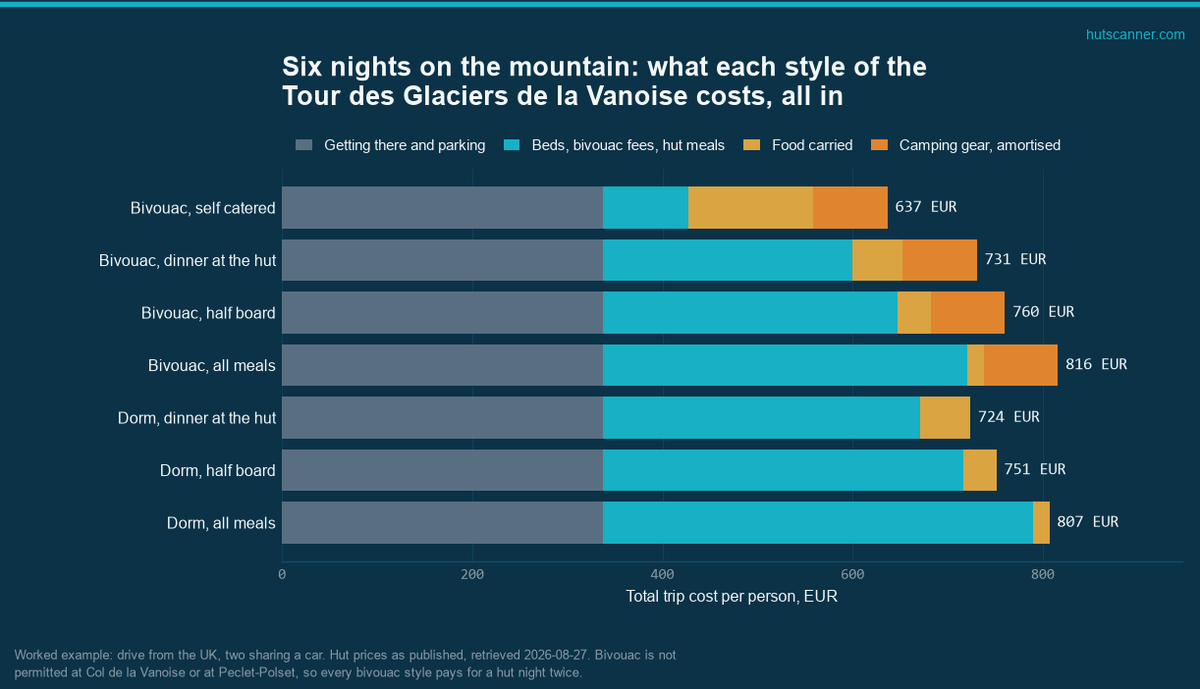
Driving from the UK, per person, in euro: bivouac self catered 636.68, bivouac with dinner 730.83, bivouac half board 760.33, bivouac all meals 815.93, dormitory with dinner 723.83, dormitory half board 751.33, dormitory all meals 806.93.
Flying to Geneva and hiring a car adds 29.92 per person to every row: bivouac self catered 666.60, dormitory half board 781.25.
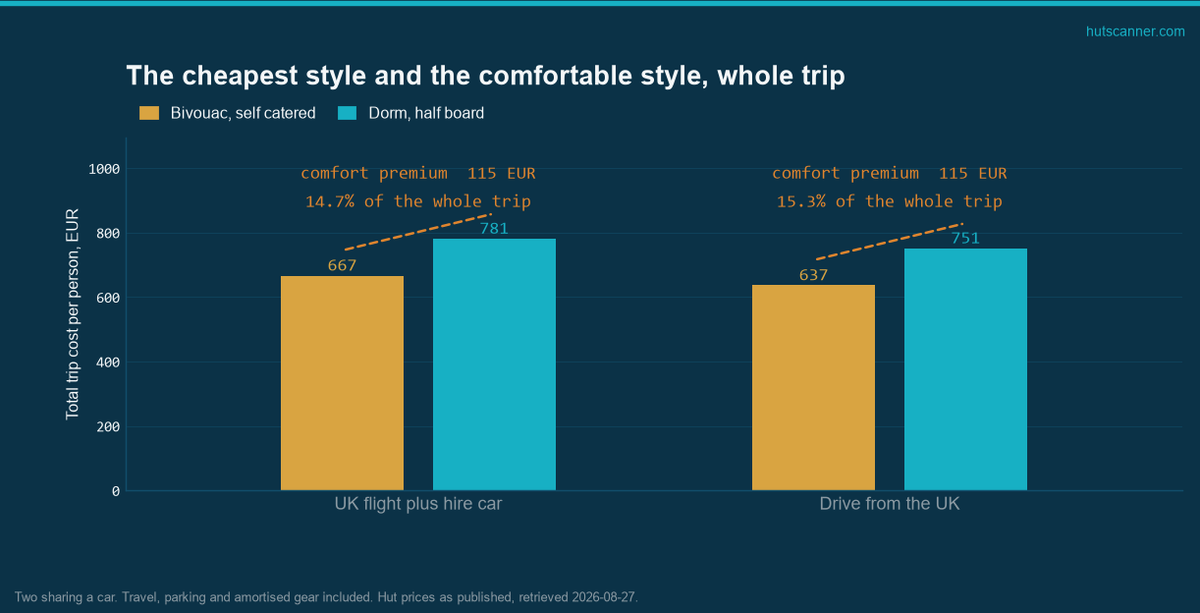
The comfort premium. Take the cheapest way to walk the loop, bivouac and self catering, and the ordinary way, a dormitory bed and half board. The difference is 114.65 EUR either way, because it is entirely on the mountain and the travel cancels out. As a share of the whole trip that is 14.7 per cent flying and hiring a car, 15.3 per cent driving. Put another way, between 45 and 55 per cent of the trip is spent before you reach the trailhead, depending on style, and the choice everyone agonises over moves about a seventh of it.
And the like-for-like comparison inverts. If you carry the tent and still eat at the huts, half board and all, the trip costs 760.33 driving against 751.33 in a dormitory. Bivouacking is 9.00 EUR more expensive. Two forced hut nights and 78.00 of amortised gear are enough to wipe out four bivouac fees of 6.00. That is the honest result and it does not flatter either side of the argument.
In sterling, at 0.856 to the euro on 26 August 2026: driving from the UK, 545.00 GBP bivouacking and self catering, 643.14 GBP in a dormitory on half board.
What you carry, and how hard it feels
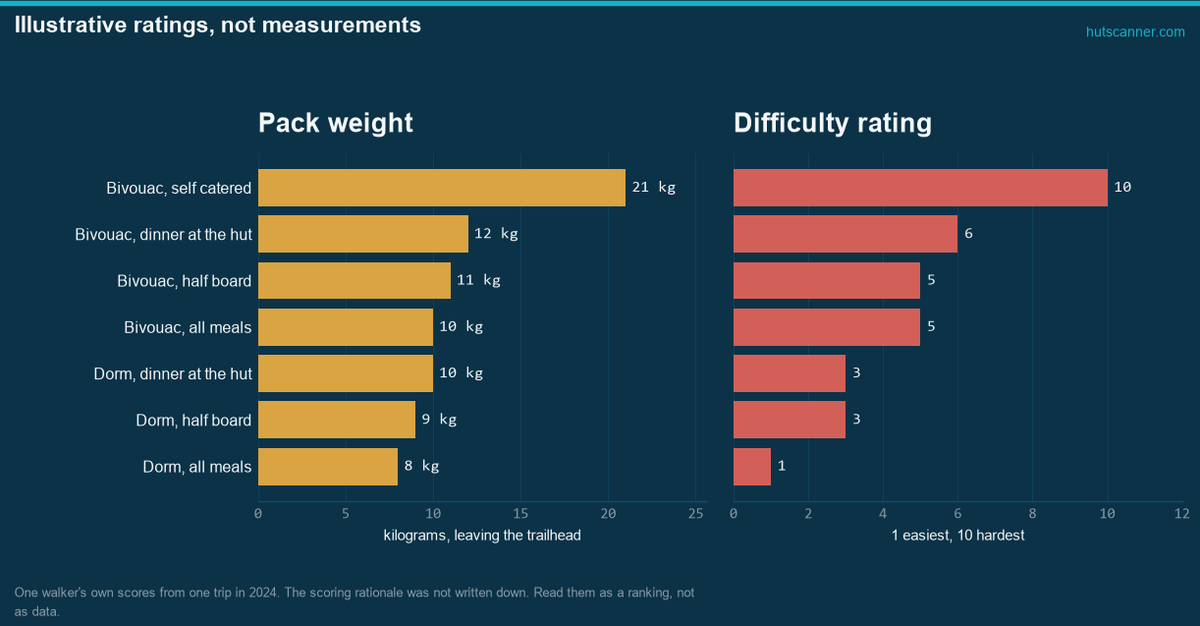
Pack weight, kilograms leaving the trailhead: bivouac self catered 21, bivouac with dinner 12, bivouac half board 11, bivouac all meals 10, dormitory with dinner 10, dormitory half board 9, dormitory all meals 8. Difficulty on a one to ten scale, in the same order: 10, 6, 5, 5, 3, 3, 1.
Read that chart carefully, because it is the weakest data on this page. See the caveats below.
Caveats
- The pack weight and difficulty numbers are one walker's own estimates from one trip, an experienced hiker scoring the 2024 route afterwards. The scoring rationale was not written down and cannot be reconstructed. They are illustrative ratings, not measurements, and they should be read as a ranking rather than as data. Everything else on this page is a published price or arithmetic on published prices.
- Prices are as retrieved on 27 August 2026 and change season to season. Two of the six huts had not published a 2026 table on that date. Refuge de la Valette's 2025 figures are used and flagged; every total that includes night 6 carries that caveat with it.
- Dinner and breakfast are not itemised at Refuge de l'Orgère or Refuge de Péclet-Polset. Where a package price exists and its parts do not, the package is used and the substitution is stated. Nothing is filled in with a guess.
- Bivouac at Vanoise huts means the hut's own designated area, reserved with the guardian, between 19h and 8h, with a capped number of places. It is not wild camping and it is not a way of avoiding the hut. For how this pattern is spreading across the Alps, the Tour du Mont Blanc 2027 rules page tracks the same shift toward paid, bookable, reservation-only bivouac zones.
- Two people sharing a car is the assumption throughout. A solo walker carries the whole car cost, which raises the fixed block and shrinks the comfort premium as a share of the trip. Four sharing does the opposite.
- The gear lifespan of ten trips is generous. At five trips the gear charge doubles to 148.00 a trip and the bivouac self-catered total rises to 706.68 driving, which cuts the comfort premium to 5.9 per cent of the trip. If you buy a tent for one trip, there is no cash case for bivouacking at all.
The part that is actually hard
None of the above is the difficult bit of planning this loop. The difficult bit is that six nights have to be six consecutive nights, at six specific huts, all of which fill on the same August weekends, and each of which is booked through its own portal. Move one night and the chain has to be rebuilt around it.
That is the problem HutScanner is built for. The Vanoise region page has the network of huts and the walking times between them, and each hut page carries its own contact and booking route. Availability tracking across the chain is what the app is being built toward: check the huts, find the nights that line up, then book each hut on its own site.
Every price on this page is the hut's, not ours. Book directly with the hut, using the links above.