Short version: there is no TMB permit today, and no law yet for 2027. On 16 September 2026 the French communes on the route approved the principles of a charter they want in place for spring 2027, with signature planned before the end of 2026. Its published outline is reservation-based: proof of a hut or bivouac-site booking to walk the tour over several days, paid and bookable bivouac areas, and checks on the trail. The text is not published and nothing in it is binding yet. Separately, bivouac rules on parts of the French section already changed for 2026, and those are in force now.
Last checked: 6 October 2026. Rules at this level change season by season; the date is part of the claim.
Three tiers, kept apart
Most coverage of the "new TMB rules" mixes three different things. This page keeps them separate, because they carry different weight when you plan.
- In force. Measures that exist today with a legal instrument behind them.
- Proposed. What the charter's authors have said publicly it will contain.
- Unknown. The charter text itself, how it would be enforced, and whether Italy and Switzerland adopt any of it.
In force for 2026
These apply now, regardless of what the charter becomes.
- Haute-Savoie prefectoral order DDT-2026-0474, in the Contamines-Montjoie reserve. Between 15 June and 15 September, bivouac is banned in the reserve's restricted zone, which the order defines as ground below 2,500 m together with zones sensitive for habitats and wildlife. It is tolerated overnight at two named places, Pont de la Rollaz (40 tents) and La Balme (50 tents). The order sets those capacities and does not itself require a reservation. It covers this reserve and nothing else.
- Haute-Savoie prefectoral order DDT-2026-0472, in the Aiguilles Rouges. A separate order covers the Aiguilles Rouges, Carlaveyron and Vallon de Bérard reserves. There, bivouac is confined to designated zones, limited to overnight hours, and reservation is compulsory.
- The Vallée des Glaciers is widely reported as closed to bivouac. It lies in Savoie, not Haute-Savoie, so neither order above covers it, and we have not found the instrument that does. Reported, not confirmed.
- Courmayeur (Italy) has banned wild camping and bivouac on its section of the tour.
- The Goûter precedent. Saint-Gervais already runs a compulsory reservation system on the normal route up Mont Blanc, enforced by municipal order. It is the model the charter's authors point to, and it shows the mechanism they can actually use: per-commune orders, not the charter itself.
What changed in September 2026
- 16 September: the charter's principles were approved. At a meeting called by Jean-Marc Peillex (Pays du Mont-Blanc) and François-Xavier Laffin (Chamonix valley), the charter's main principles "ont été approuvés à l'unanimité", according to the Chamonix valley communes' communiqué of 22 September. They agreed what the charter will contain, not its final text. The French hiking federation (FFRandonnée) reported it on 24 September, which is the date some coverage gives. The outline matches the one below: compulsory reservation of accommodation in summer (huts, hotels and campsites), no wild bivouac outside managed areas with a fixed capacity and a fee per pitch, and a Green Brigade checking reservations.
- 28 September: the first cross-border meeting. The mayors of Courmayeur, Chamonix-Mont-Blanc, Saint-Gervais and Orsières (Switzerland) met in Chamonix, and agreed to meet there again at the end of October to set out a joint plan. The French communes invited Italy and Switzerland to join the process. Courmayeur's mayor described the shared aim as "not to restrict access to the Tour, but to direct visitor flows towards officially registered accommodation", in the Italian press's account. Courmayeur has put information boards on its section and has begun removing wild-camping spots from online maps and social media.
- A survey figure is circulating. Officials at the meeting cited a survey taken during UTMB race week, with 15,000 respondents, in which 29% of Tour du Mont Blanc hikers did not book accommodation. The survey has not been published, and the press reports it both as "did not book" and as "bivouacked outside the rules", which are not the same thing. Treat it as the figure the charter's supporters are using, not as a measured share.
Proposed for 2027
The instrument is a charter (a "charte") being drafted jointly by the Communauté de communes Pays du Mont-Blanc, whose president Jean-Marc Peillex is the mayor of Saint-Gervais, and the Chamonix valley communes. The target is summer 2027. What Peillex has described publicly, in an interview with Outside France and in local radio coverage:
- Proof of reservation to walk the TMB over multiple days. A hut or bivouac-site booking for each night. This is an indirect capacity cap: the number of beds and pitches sets the ceiling, without a separate permit or quota.
- Paid, equipped, reservation-only bivouac areas in place of unregulated bivouac along the route.
- A "Green Brigade" checking reservations on the trail, with fines for walkers who have none.
- Limits on baggage transfer: only trekking bags, at set times, according to the communiqué; Peillex has also described capping how many rotations the transfer companies can run.
- A "Tour du Mont-Blanc" label for every business and body that signs the charter.
- A booklet sold to walkers, explaining what is expected of them, which can be stamped at each stage.
The official timeline, from the same communiqué: the text finalised in mid-October 2026, signed by the local authorities and partners before the end of 2026, and in operation in spring 2027. The communiqué itself does not mention fines; those come from Peillex's interviews.
A point the headlines get wrong in both directions: it is not accurate to say a permit is planned, and it is not accurate to say nothing is planned. No permit exists today. The mechanism described is reservation-based rather than a quota permit, Peillex has explicitly backed checks and fines, and the final form is unpublished.
Unknown
- The charter text. The principles are approved; as of 17 October 2026 the text is neither published nor signed. Everything in the section above comes from interviews and announcements.
- How it binds. A charter is not itself law. To enforce any of it, each commune would need to pass its own order, the way Saint-Gervais did for the Goûter. Whether every commune on the French section does so, and with matching rules, is open.
- Italy and Switzerland. Both are invited and neither has committed. Orsières took part in the 28 September meeting and has said it wants the three countries to coordinate before anything is adopted; no Swiss measure is announced. Italy has the Courmayeur bivouac ban, and a Courmayeur councillor has backed the French approach, but nothing further is announced. A French-only charter covers roughly half the loop.
- Enforcement in practice. The Green Brigade is described, not staffed. What a check on the trail looks like, and what counts as proof, is not defined.
What it means for a 2027 Tour du Mont Blanc
Whatever the charter's final form, the direction is the same: a bed or a booked pitch for every night, and something to show for it. That is already how the tour works in practice in July and August, when the huts on the waymarked line are among the first in the Alps to fill. The proposal turns a planning habit into a requirement.
Practically:
- Book a chain of nights, not a list of huts. The constraint is consecutive nights in trail order. A hut with space on the wrong night is not a bed.
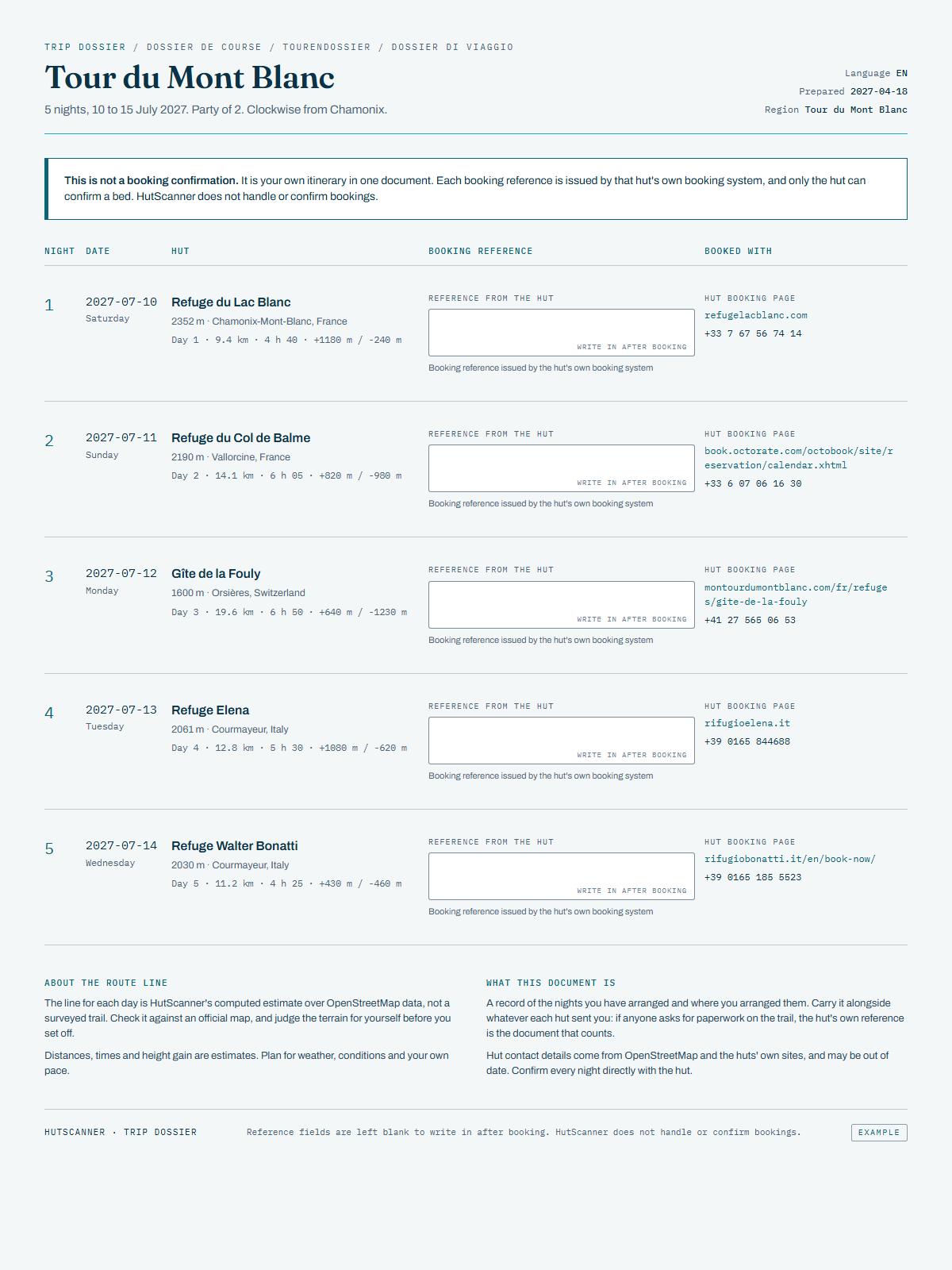
- Book each hut on its own system. Huts on the tour reserve through several different portals, and the reference each one issues is the document that counts. Keep those references together in one place.
- Expect the bivouac option to narrow, not vanish. The 2026 orders above already removed the assumption of an unregulated pitch on parts of the French section; the charter would extend that to the whole French side, with booking.
- Watch the source, not the coverage. When the charter is published, the prefecture and the CCPMB will carry it before the press does. This page will be updated from those sources and the "last checked" date above will move.
Sources
Primary sources are cited where they exist; press coverage fills the gaps.
- Préfecture de la Haute-Savoie, orders DDT-2026-0474 (Contamines-Montjoie) and DDT-2026-0472 (Aiguilles Rouges, Carlaveyron, Vallon de Bérard), both 2026 (haute-savoie.gouv.fr, recueil des actes administratifs). The copies we read carry no signature date, so this page cites them by number and year only.
- Communauté de communes de la Vallée de Chamonix-Mont-Blanc, "Tour du Mont-Blanc : des décisions essentielles pour redonner à ce trek toutes ses valeurs", 22 September 2026 (cc-valleedechamonixmontblanc.fr).
- Comune di Courmayeur, report of the 28 September 2026 cross-border meeting in Chamonix, 28 September 2026 (comune.courmayeur.ao.it).
- Communauté de communes Pays du Mont-Blanc and Saint-Gervais communiqués (saintgervais.com).
- FFRandonnée, "Une charte va réguler l'accès au Tour du Mont Blanc à pied", 24 September 2026 (ffrandonnee.fr).
- Il Dolomiti, report of the 28 September 2026 cross-border mayors' meeting in Chamonix, 29 September 2026 (ildolomiti.it), with quotes first given to AostaSera.
- Outside France, interview with Jean-Marc Peillex on the charter's contents (outside.fr).
- Radio Mont Blanc, charter announcement (radiomontblanc.fr).
- Haute-Savoie tourism board, regulation overview (tourisme-haute-savoie.com).
- RTS and Euronews on the Swiss position and cross-border coordination.
- u-Trail, analysis noting that no concrete measure has yet been unveiled (u-trail.com).
Plan the nights first
HutScanner checks the huts' own booking calendars daily and searches for runs of huts with space on consecutive nights in trail order. The Tour du Mont Blanc region page has the stages and the map, and the daily availability page shows whether a bookable loop exists right now. Booking is done directly with each hut, on its own site.